

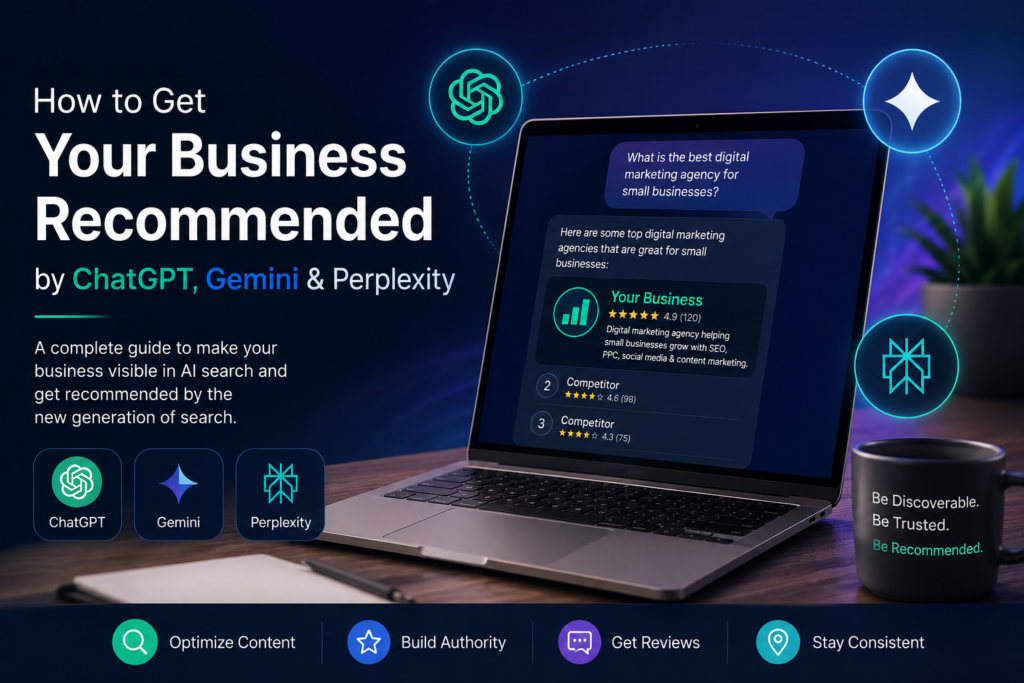
Imagine a potential customer asking ChatGPT:
“What is the best digital marketing agency for a small business?”
Instead of searching Google, they get a list of recommendations directly inside an AI conversation.
Your competitors appear.
Your business doesn’t.
That is becoming an important digital marketing problem.
Search is no longer limited to traditional search engines and the familiar list of blue links. ChatGPT can search the web and provide answers with links to relevant sources, while Microsoft’s AI Performance tools now allow website owners to see when their content is cited in AI-generated answers across supported AI experiences.
This creates a new question for businesses:
How do you make your business more visible when customers ask AI for recommendations?
The answer isn’t to find a secret “ChatGPT ranking trick.” There isn’t one.
Instead, businesses need to build the kind of credible, useful, well-structured and discoverable online presence that search engines and AI systems can understand and reference.
Let’s look at how to do it.
What Is AI Search Optimization?
AI search optimization is the process of improving your online presence so that AI-powered search experiences can better understand your business, products, services and expertise.
You may also hear terms such as:
- AI SEO
- Generative Engine Optimization (GEO)
- Answer Engine Optimization (AEO)
- AI search optimization
These terms overlap, but the underlying objective is similar: make your business and its information easier for modern search systems to discover, understand and potentially reference.
Traditional SEO has largely focused on questions such as:
“How can I rank higher on Google?”
AI search introduces another question:
“How can I become a useful and trustworthy source when an AI answers my customer’s question?”
That difference matters.
Why AI Recommendations Matter for Businesses
Consumers increasingly use conversational interfaces to research products, services and businesses.
ChatGPT Search, for example, can search the web and return answers containing links to relevant sources. OpenAI explains that ChatGPT may automatically search the web when a question would benefit from current information.
That means your website is no longer competing only for traditional search rankings.
Your content may also need to compete for visibility within AI-generated answers.
Microsoft has already introduced AI Performance reporting in Bing Webmaster Tools, allowing website owners to see cited pages, citation activity and the queries associated with content appearing in AI-generated answers.
However, there is an important distinction:
Being cited by an AI system is not the same as receiving traffic, ranking first or being recommended as the best business.
AI visibility should therefore be treated as another layer of your overall search strategy—not a replacement for traditional SEO.
1. Build a Website That Clearly Explains What Your Business Does
This sounds obvious, but many businesses make it surprisingly difficult for search engines and AI systems to understand them.
Your homepage should clearly communicate:
- Who you are
- What you offer
- Who you serve
- Where you operate
- What makes you different
- How customers can contact you
For example, don’t simply write:
“We deliver innovative digital solutions for modern businesses.”
That sounds professional, but it tells a potential customer very little.
A clearer version would be:
“We are a digital marketing agency in Jammu helping small and medium-sized businesses generate leads through SEO, Google Ads, social media marketing and content marketing.”
The second version gives search systems much more context.
It identifies the:
Business + service + location + audience + value proposition.
Clear information is easier for both humans and machines to interpret.
2. Create Content Around Real Customer Questions
One of the biggest mistakes businesses make with SEO is creating content around keywords instead of customer problems.
AI search is conversational.
People don’t always ask:
“Digital marketing agency Jammu.”
They may ask:
“Which digital marketing agency in Jammu is good for a small business?”
Or:
“How much does digital marketing cost for a small business?”
Or:
“Should I hire a digital marketing agency or freelancer?”
These are completely different types of searches.
Your content strategy should therefore address the questions your customers actually ask before making a purchase.
Create useful content around:
- Problems
- Comparisons
- Costs
- Processes
- Alternatives
- Frequently asked questions
- Product or service use cases
- Industry-specific challenges
- Local questions
This can help build topical relevance while giving search engines and AI systems more useful information to work with.
3. Demonstrate Real Expertise, Not Generic AI Content
This may become one of the biggest differentiators in AI-era SEO.
Anyone can ask an AI tool to generate a 2,000-word article.
That means generic content is becoming increasingly easy to produce.
Your advantage is first-hand knowledge.
Instead of writing:
“SEO is important because it increases website traffic.”
Show what you have actually learned.
For example:
- Share campaign insights
- Explain real client challenges
- Include original research
- Present case studies
- Use industry-specific examples
- Explain what worked and what didn’t
- Include expert opinions
- Add data from your own campaigns
The objective is to give readers something they cannot get from hundreds of generic articles.
AI can generate information. Your business needs to demonstrate experience.
4. Build Your Brand Beyond Your Own Website
Your website is important, but it shouldn’t be the only place your business exists online.
Think about your overall digital footprint.
A potential customer—or an AI search system—may encounter your business through:
- Your website
- Google Business Profile
- Business directories
- Industry publications
- Review platforms
- Social media
- YouTube
- News articles
- Interviews
- Podcasts
- Industry communities
- Third-party websites
The more consistently your business is represented across legitimate sources, the easier it becomes to establish a coherent online identity.
But don’t confuse this with creating hundreds of low-quality directory listings.
Quality and relevance matter more than volume.
A few credible, relevant mentions can be more valuable than dozens of meaningless profiles.
5. Get Genuine Reviews and Customer Mentions
Reviews are particularly important for local businesses.
Suppose someone asks:
“What is the best salon near me?”
An AI system needs information about businesses that actually exist, their locations, services, reputation and relevance.
That’s why businesses should maintain accurate information across major platforms and actively encourage genuine customer feedback.
For local businesses, keep information such as:
- Business name
- Address
- Phone number
- Opening hours
- Website
- Services
- Categories
accurate and consistent.
Microsoft specifically recommends keeping local business information current through Bing Places for Business so key details can remain accurate and eligible for inclusion in AI-generated responses.
And remember:
Never buy fake reviews simply to manufacture credibility.
A strong reputation should come from real customer experiences.
6. Create Dedicated Pages for Your Services
If your business offers multiple services, don’t hide everything under one generic “Services” page.
Suppose you run a digital marketing agency offering:
- SEO
- Google Ads
- Social media marketing
- Website development
- Content marketing
Create useful, dedicated pages for each major service.
For example:
/seo-services/
/google-ads-management/
/social-media-marketing/
Each page should clearly explain:
- What the service is
- Who it is for
- Problems it solves
- How your process works
- What customers can expect
- Pricing considerations where appropriate
- Examples or case studies
- FAQs
- Why your company is qualified
This gives search engines and AI systems clearer topical signals about your business.
7. Make Your Content Easy to Understand and Extract
AI systems need to process information efficiently.
That doesn’t mean writing robotic content.
It means making your content clear and well structured.
Use:
Descriptive headings
Instead of:
“Our Approach”
Try:
“How Our SEO Process Works for Small Businesses”
Short paragraphs
Avoid walls of text.
Lists
Use bullet points where information can be presented more clearly.
Direct answers
If you ask a question in a heading, answer it immediately.
For example:
How Much Does SEO Cost?
SEO pricing depends on factors such as business size, competition, website condition, target locations and the scope of work. Small businesses may require a different SEO strategy from national brands competing across hundreds of keywords.
Then expand on the subject.
This structure benefits human readers and makes important information easier to identify.
Microsoft’s AI Performance guidance similarly recommends clear structure, descriptive headings, concise sections and FAQ-style content when improving content for AI-generated answers.
8. Use Facts, Sources and Original Data
If you’re making an important claim, support it.
Instead of writing:
“Video marketing is the future.”
Explain why you believe that.
Use:
- Original research
- Government statistics
- Industry reports
- Academic research
- Official documentation
- First-party business data
- Credible third-party sources
This improves the credibility of your content.
It also gives AI systems clearer, verifiable information to work with.
Your goal should not be:
“Write content that tricks AI into mentioning my company.”
Your goal should be:
“Build a digital presence that deserves to be mentioned.”
That is a much stronger long-term strategy.
9. Don’t Abandon Traditional SEO
This is where many businesses can make a serious mistake.
AI search does not mean traditional SEO is obsolete.
Your website still needs to be:
- Crawlable
- Indexable
- Technically sound
- Fast
- Mobile-friendly
- Secure
- Well structured
- Relevant to search intent
Your traditional SEO foundation still matters because AI search experiences rely on information retrieved from the web.
OpenAI states that ChatGPT Search searches the web and provides links to relevant sources, while Bing’s AI Performance documentation notes that its AI systems cite content that is eligible for indexing.
Think of AI search optimization as an extension of strong SEO, not a replacement for it.
10. Track AI Visibility—But Don’t Obsess Over One Prompt
One of the biggest problems with AI search measurement is that AI answers can change.
Ask the same question at different times and you may not necessarily get identical results.
Therefore, don’t measure your entire strategy by asking ChatGPT:
“Who is the best digital marketing agency in Jammu?”
once a week.
Instead, build a broader measurement framework.
Track:
- Organic search traffic
- Search impressions
- Organic clicks
- Branded searches
- Referral traffic
- Conversions
- Leads
- Mentions
- AI citations where measurable
- Which pages receive AI citations
- Which topics generate visibility
Bing’s AI Performance report can now show citation activity, cited pages and associated grounding queries across supported AI experiences. Microsoft also explicitly warns that citation data does not represent rankings, traffic or engagement.
That distinction is critical.
Visibility is not the same as conversion.
Ultimately, the goal isn’t simply to appear in an AI answer.
The goal is to be discovered, trusted and chosen.
A Practical AI SEO Strategy for Small Businesses
If you’re a small business owner, you don’t need to implement everything at once.
Start with this six-step process:
Step 1: Fix your business information
Make sure your website, Google Business Profile and relevant business listings contain accurate information.
Step 2: Improve your core pages
Clearly explain your products, services, locations and value proposition.
Step 3: Research customer questions
Find the questions people ask before buying from you.
Step 4: Create genuinely useful content
Answer those questions better than your competitors.
Step 5: Build authority
Collect genuine reviews, earn relevant mentions and publish original insights.
Step 6: Measure and improve
Monitor traditional SEO performance and emerging AI visibility signals.
Do this consistently rather than chasing every new AI marketing trend.
What NOT to Do If You Want AI Visibility
The rise of AI search will inevitably create shortcuts and questionable tactics.
Avoid strategies such as:
- Keyword stuffing
- Fake reviews
- Mass-produced low-quality AI articles
- Fake business listings
- Manipulative backlinks
- Publishing hundreds of near-identical pages
- Making unsupported claims
- Copying competitor content
- Trying to manipulate AI responses with spam
These tactics may create short-term noise, but they don’t create a trustworthy brand.
And AI search is evolving rapidly.
A strategy that appears to work today may become ineffective tomorrow.
The Future of SEO Isn’t Google vs. ChatGPT
The biggest change in digital marketing isn’t that Google suddenly disappears and ChatGPT takes its place.
The reality is more complicated.
Consumers now have multiple discovery environments.
They may discover a business through:
Google → Instagram → YouTube → Reddit → Maps → ChatGPT → Gemini → Perplexity → a friend’s recommendation
The customer journey is becoming fragmented.
That means businesses need to think beyond:
“How do I rank for this keyword?”
and start thinking:
“How easily can customers discover, understand and trust my brand wherever they search?”
That’s the real opportunity behind AI search optimization.
Final Takeaway: Don’t Try to Trick AI—Become the Business AI Can Trust
There is no guaranteed formula for making ChatGPT, Gemini or Perplexity recommend your business.
And anyone promising a guaranteed position in an AI-generated answer should be treated cautiously.
Instead, build the fundamentals:
Create useful content.
Demonstrate real expertise.
Keep your business information accurate.
Earn genuine reviews and mentions.
Build a technically strong website.
Answer the questions your customers actually ask.
Support important claims with credible evidence.
Measure both traditional SEO and emerging AI visibility.
The businesses that succeed in AI search won’t necessarily be the ones that publish the most content.
They will be the ones that become the clearest, most useful and most credible sources in their niche.
And that is ultimately what good SEO has always been about.
Frequently Asked Questions
How can I get my business recommended by ChatGPT?
There is no guaranteed method for getting ChatGPT to recommend a particular business. The practical approach is to build a credible online presence with clear business information, authoritative content, genuine reviews, relevant third-party mentions and a technically accessible website.
Is ChatGPT SEO the same as traditional SEO?
Not exactly. Traditional SEO focuses heavily on visibility in search-engine results, while AI search optimization also considers whether content can be discovered, understood and referenced within AI-generated answers. The two strategies overlap significantly, so strong technical SEO and useful content remain important.
What is Generative Engine Optimization (GEO)?
Generative Engine Optimization, commonly called GEO, refers broadly to optimizing content and brand visibility for generative AI and AI-powered search experiences. It is closely related to terms such as AI SEO and Answer Engine Optimization (AEO).
Can AI search replace Google?
Not necessarily. AI search is changing how people discover information, but traditional search engines remain important. A strong digital marketing strategy should optimize for multiple discovery channels rather than relying exclusively on either Google or AI platforms.
Does getting cited by an AI mean I will receive website traffic?
No. A citation means your content was referenced as a source; it does not automatically mean that someone clicked through to your website. Microsoft’s AI Performance documentation explicitly distinguishes citation activity from traffic, rankings and engagement.
Should I use AI to write SEO content?
AI can be useful for research, outlining, brainstorming and drafting. However, publishing large volumes of generic AI-generated content is not a substitute for expertise. Add original insights, first-hand experience, credible sources, examples and meaningful analysis to make the content genuinely useful.
-
How to Get Your Business Recommended by ChatGPT, Gemini & Perplexity in 2026
Imagine a potential customer asking ChatGPT: “What is the best digital marketing agency for a small business?” Instead of searching Google, they get a list of recommendations directly inside an AI conversation. Your competitors appear. Your business doesn’t. That is becoming an important digital marketing problem. Search is no longer limited to traditional search engines…