

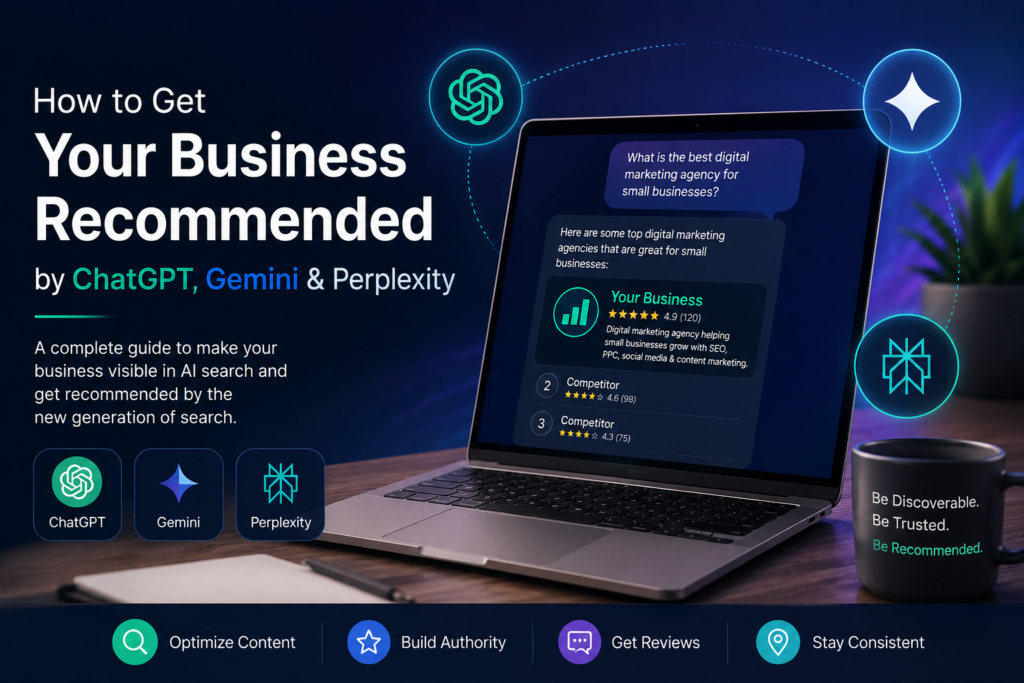
How to Get Your Business Recommended by ChatGPT, Gemini & Perplexity in 2026
Imagine a potential customer asking ChatGPT: “What is the best digital marketing agency for a small business?” Instead of searching Google, they get a list of recommendations directly inside an AI conversation. Your competitors appear. Your business doesn’t. That is becoming an important digital marketing problem. Search is no longer limited to traditional search engines and the familiar list of blue links. ChatGPT can search the web and provide answers with links to relevant sources, while Microsoft’s AI Performance tools now allow website owners to see when their content is cited in AI-generated answers across supported AI experiences. This creates a new question for businesses: How do you make your business more visible when customers ask AI for recommendations? The answer isn’t to find a secret “ChatGPT ranking trick.” There isn’t one. Instead, businesses need to build the kind of credible, useful, well-structured and discoverable online presence that search engines and AI systems can understand and reference. Let’s look at how to do it. What Is AI Search Optimization? AI search optimization is the process of improving your online presence so that AI-powered search experiences can better understand your business, products, services and expertise. You may also hear terms such as: These terms overlap, but the underlying objective is similar: make your business and its information easier for modern search systems to discover, understand and potentially reference. Traditional SEO has largely focused on questions such as: “How can I rank higher on Google?” AI search introduces another question: “How can I become a useful and trustworthy source when an AI answers my customer’s question?” That difference matters. Why AI Recommendations Matter for Businesses Consumers increasingly use conversational interfaces to research products, services and businesses. ChatGPT Search, for example, can search the web and return answers containing links to relevant sources. OpenAI explains that ChatGPT may automatically search the web when a question would benefit from current information. That means your website is no longer competing only for traditional search rankings. Your content may also need to compete for visibility within AI-generated answers. Microsoft has already introduced AI Performance reporting in Bing Webmaster Tools, allowing website owners to see cited pages, citation activity and the queries associated with content appearing in AI-generated answers. However, there is an important distinction: Being cited by an AI system is not the same as receiving traffic, ranking first or being recommended as the best business. AI visibility should therefore be treated as another layer of your overall search strategy—not a replacement for traditional SEO. 1. Build a Website That Clearly Explains What Your Business Does This sounds obvious, but many businesses make it surprisingly difficult for search engines and AI systems to understand them. Your homepage should clearly communicate: For example, don’t simply write: “We deliver innovative digital solutions for modern businesses.” That sounds professional, but it tells a potential customer very little. A clearer version would be: “We are a digital marketing agency in Jammu helping small and medium-sized businesses generate leads through SEO, Google Ads, social media marketing and content marketing.” The second version gives search systems much more context. It identifies the: Business + service + location + audience + value proposition. Clear information is easier for both humans and machines to interpret. 2. Create Content Around Real Customer Questions One of the biggest mistakes businesses make with SEO is creating content around keywords instead of customer problems. AI search is conversational. People don’t always ask: “Digital marketing agency Jammu.” They may ask: “Which digital marketing agency in Jammu is good for a small business?” Or: “How much does digital marketing cost for a small business?” Or: “Should I hire a digital marketing agency or freelancer?” These are completely different types of searches. Your content strategy should therefore address the questions your customers actually ask before making a purchase. Create useful content around: This can help build topical relevance while giving search engines and AI systems more useful information to work with. 3. Demonstrate Real Expertise, Not Generic AI Content This may become one of the biggest differentiators in AI-era SEO. Anyone can ask an AI tool to generate a 2,000-word article. That means generic content is becoming increasingly easy to produce. Your advantage is first-hand knowledge. Instead of writing: “SEO is important because it increases website traffic.” Show what you have actually learned. For example: The objective is to give readers something they cannot get from hundreds of generic articles. AI can generate information. Your business needs to demonstrate experience. 4. Build Your Brand Beyond Your Own Website Your website is important, but it shouldn’t be the only place your business exists online. Think about your overall digital footprint. A potential customer—or an AI search system—may encounter your business through: The more consistently your business is represented across legitimate sources, the easier it becomes to establish a coherent online identity. But don’t confuse this with creating hundreds of low-quality directory listings. Quality and relevance matter more than volume. A few credible, relevant mentions can be more valuable than dozens of meaningless profiles. 5. Get Genuine Reviews and Customer Mentions Reviews are particularly important for local businesses. Suppose someone asks: “What is the best salon near me?” An AI system needs information about businesses that actually exist, their locations, services, reputation and relevance. That’s why businesses should maintain accurate information across major platforms and actively encourage genuine customer feedback. For local businesses, keep information such as: accurate and consistent. Microsoft specifically recommends keeping local business information current through Bing Places for Business so key details can remain accurate and eligible for inclusion in AI-generated responses. And remember: Never buy fake reviews simply to manufacture credibility. A strong reputation should come from real customer experiences. 6. Create Dedicated Pages for Your Services If your business offers multiple services, don’t hide everything under one generic “Services” page. Suppose you run a digital marketing agency offering: Create useful, dedicated pages for each major service. For example: /seo-services/ /google-ads-management/ /social-media-marketing/ Each page should clearly explain: